
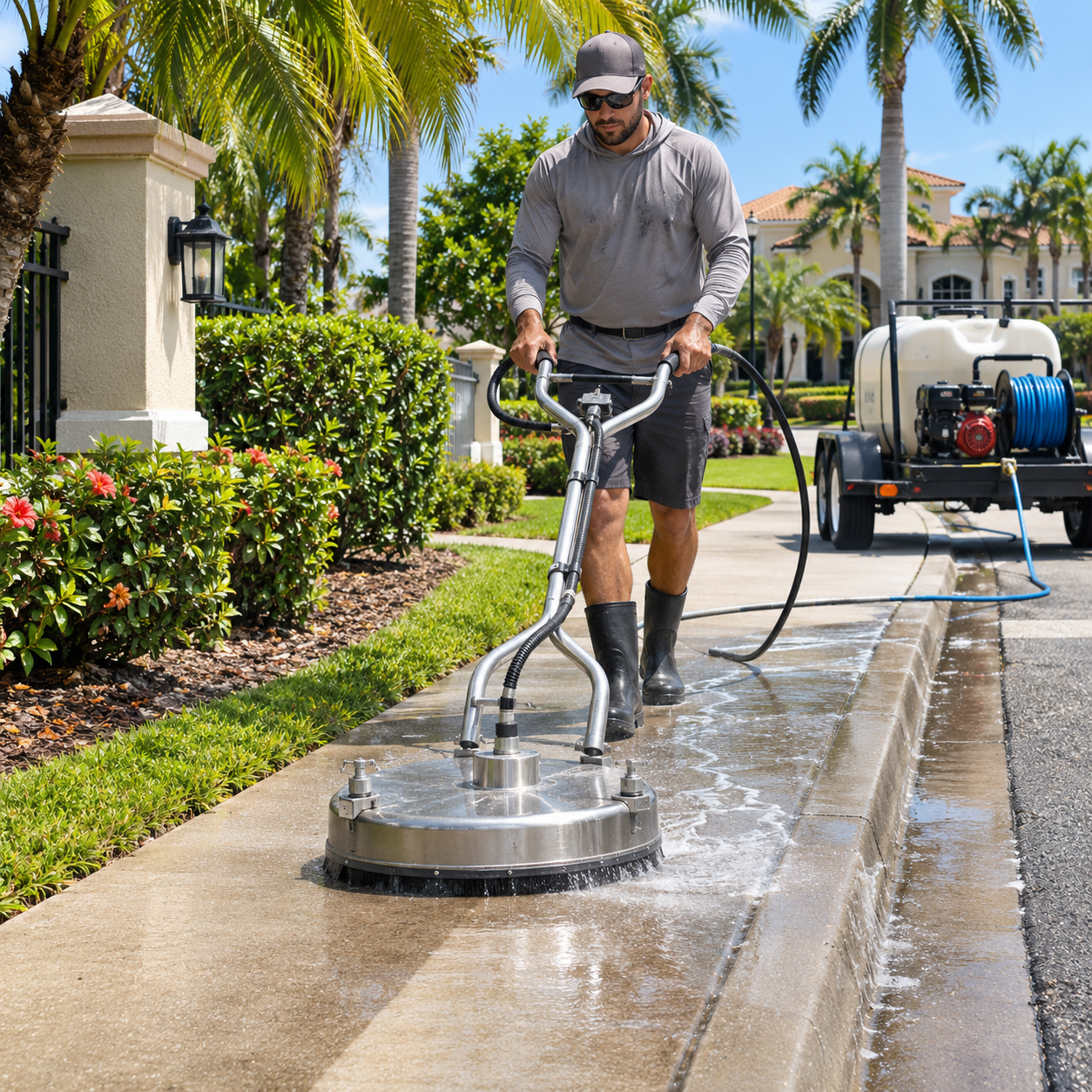
How Often Should HOAs Pressure Wash Sidewalks in Florida?
If you manage an HOA, you know how quickly one tired-looking stretch of sidewalk can stand out beside an otherwise well-kept entrance. But deciding when to pressure wash a whole community isn’t as simple as putting “sidewalk cleaning” on the calendar every spring.
The short answer: Under normal conditions, many Florida communities use six to twelve months as a starting point for evaluating professional sidewalk cleaning. That’s a planning range, not a rule. Shaded paths and constantly damp areas may need attention sooner; clean, sunny stretches can often go longer. And before anyone schedules a wash, the association needs to check whether the work is permitted under current water-use restrictions.
For HOA boards and property managers in Sarasota, Bradenton, Lakewood Ranch and surrounding communities, a condition-based plan is usually more useful than treating every walkway the same.
Request a free property wash consultation or call (941) 259-1469 to discuss your walkways and curbs.
Start With Inspections, Not an Automatic Washing Schedule
A useful maintenance calendar tells you when to look, not necessarily when to wash. A brief walk-through, a few photos and notes about recurring trouble spots can keep the association from paying to clean surfaces that don’t need it—or overlooking the ones residents use most.
Here’s a practical starting point for inspections:
| Community area | Suggested inspection rhythm | What to look for |
|---|---|---|
| Clubhouse entrances, mailbox areas and frequently used paths | Monthly | Slippery-looking films, stains, tracked-in debris and trouble spots near ramps |
| Shaded walks and paths beside irrigation zones | Every 1–2 months | Persistent dampness, green or dark buildup and repeated staining |
| Open, sunnier sidewalks | Every 3–6 months | Accumulating grime and areas that stay wet unexpectedly |
| Curbs and crossing points | Quarterly | Stubborn buildup at the pavement edge, drainage concerns and pedestrian access |
These are suggested inspection intervals, not mandatory cleaning frequencies or guarantees about how quickly buildup develops. The right plan will depend on the property.
Why Two Sidewalks in the Same Neighborhood Can Need Different Attention
Picture two paths in a Sarasota community. One is exposed to sun for most of the day. The other sits beneath trees, beside a heavily irrigated planting bed. Even if both were cleaned on the same date, they may look very different three months later.
Shade and moisture matter because damp surfaces can support recurring organic buildup. Irrigation overspray adds another source of moisture and can leave mineral marks. Tree litter, nearby landscaping and how frequently residents use a path also affect how quickly a surface looks dirty.
The sidewalk material matters, too. Standard concrete, decorative concrete and pavers don’t respond identically to cleaning. Aging surfaces, failing joints and existing cracks deserve an assessment before high pressure is applied.
That’s why an HOA-wide maintenance plan might recommend one approach for the main entrance and a different one for a shaded walkway behind the clubhouse. It shouldn’t assume every square foot needs the same treatment at the same time.
Four Signs It’s Time to Investigate Sidewalk Cleaning
A little ordinary dust doesn’t necessarily justify a professional wash. These situations deserve a closer look:
- A slippery or slimy film develops. Pay particular attention to shaded paths, ramps and places where residents have reported losing traction. Keep people away from an unsafe area while it is assessed.
- Dark or green buildup keeps returning. If the same stretch repeatedly develops algae or mildew, examine the moisture source as well as the surface itself.
- Routine sweeping doesn’t remove the problem. Loose leaves, sand and grit should be handled with simpler maintenance first. Adhered buildup may require a different method.
- Staining is concentrated in a few locations. A curb near an irrigation head or a busy entrance may need targeted attention rather than a full-community project.
Remember that pressure washing doesn’t repair broken concrete, raised sidewalk panels or drainage defects. Those are separate maintenance issues and should be handled as such.
Important: Florida Water Restrictions Can Change What HOAs May Schedule
As of November 2026, the Southwest Florida Water Management District’s Modified Phase III water-shortage restrictions are in effect through March 31, 2027, including Sarasota and Manatee counties.
Under the current rules, annual pressure washing purely for appearance is not allowed. Washing sidewalks and other hard surfaces may be allowed when it is necessary maintenance—for example, addressing mold, mildew or potentially hazardous material that cannot be removed by mechanical methods, or preparing a surface for painting or sealing.
An HOA appearance standard alone does not make pressure washing necessary maintenance, and associations cannot enforce certain requirements that compel homeowners to increase water use simply to meet aesthetic standards.
These are important distinctions for board budgets and resident notices. Before approving a project, confirm the applicable restrictions and any stricter local rules, and discuss the intended work with the contractor.
For current official guidance, see the Southwest Florida Water Management District’s water restrictions.
Note: Water-use orders change. Recheck the rules whenever this article is updated or a cleaning project is scheduled.
Is Pressure Washing Always the Right Way to Clean HOA Walkways?
No. The appropriate method depends on the surface, its condition and the type of buildup.
Professional pressure washing for suitable hard surfaces can be appropriate for many concrete walkways and curbs. But more pressure isn’t automatically better.
Decorative finishes, aging concrete, paver joints and certain permeable surfaces can be damaged or require a different maintenance method. A contractor should assess the material before choosing equipment, pressure and cleaning products.
It’s also worth asking what happens to the wash water.
Sarasota County explains that storm drains discharge to local waterways rather than a treatment plant, and advises keeping pollutants out of drains. The county’s stormwater guidance is a useful reference when discussing runoff control, loose debris and nearby landscaping with a contractor.
How to Plan a Community Cleaning Project Without Wasting the Budget
For an HOA board, the biggest improvement is often a clearer scope rather than a bigger contract.
Start by walking the community with a simple map. Mark the sidewalk runs that are genuinely affected, take dated photographs and separate three categories: areas that only need sweeping, areas that may need professional cleaning, and areas needing physical repair.
Check whether each section falls under HOA, CDD or another party’s maintenance responsibility before committing funds.
Next, ask for a proposal that identifies the surfaces and quantities being quoted, the cleaning approach, how residents will retain access to mailboxes and entrances, and how runoff will be managed.
If the work covers a large community, discuss whether it can be handled in zones to reduce disruption.
Royal Tide Property Wash offers exterior cleaning for HOAs and multi-residential properties, including property assessment and a written proposal. That can give a board something concrete to review instead of approving a vague “wash all sidewalks” line item.
Once the work is completed, keep before-and-after photographs and note any areas where buildup returns quickly. Those records will help the next board or property manager make better decisions about timing and budgeting.
What Can an HOA Do Between Professional Cleanings?
Quite a bit.
Removing loose debris, keeping landscaping trimmed away from walkways, checking irrigation heads for overspray and promptly addressing drainage problems can reduce the conditions that contribute to recurring buildup.
And if one section becomes slick or otherwise unsafe, don’t wait for the next scheduled community-wide inspection. Restrict access as appropriate and have the problem assessed. It may call for cleaning, repair or both.
The goal is to maintain usable shared spaces—not to pressure wash on principle.
A Better Cleaning Schedule Starts With the Property
So, how often should a Florida HOA pressure wash its sidewalks?
Inspect regularly, consider professional cleaning when the condition warrants it, and schedule only work allowed under the rules in effect.
For some communities that means reviewing cleaning needs around the six- or twelve-month mark. Others will get better results from targeted work in problem areas rather than a blanket wash.
If you manage an HOA or condo community in Sarasota or Manatee County, Royal Tide Property Wash can help evaluate the areas that need attention and provide a clear, property-specific estimate.
Request a free property wash consultation or call (941) 259-1469 to discuss your walkways and curbs.